
It is apparent that the world is experiencing less Freedom of Expression when comparing the turn of the century to today. In Eastern Africa, all the countries are rated as Not Free except for Kenya, which is classed as Partially Free. As matters currently stand in the region, this is unlikely to change in the foreseeable future. This is a commentary and comments are welcome by email to: info@eaa.co.ke . The views expressed here are not necessarily those of the Association.
FREEDOM IN PERIL
What is Freedom of Speech
“Everyone has the right to freedom of opinion and expression; this right includes freedom to hold opinions without interference and to seek, receive and impart information and ideas through any media and regardless of frontiers”. Article 19 UNDHR
The United Nations Declaration of Human Rights (UNDHR) was introduced on 10th December 1948 under General Assembly Resolution 217 A. It was designed to be a “common standard of achievements for all peoples and all nations”. The Declaration established the “fundamental human rights to be universally protected and it has been translated into over 500 languages”.
Merriam- Webster Dictionary defines freedom of speech as: “the right to express information, ideas, and opinions free of Government restrictions based on content and subject only to reasonable limitations (as the power of the Government to avoid a clear and present danger) especially as guaranteed by the First and Fourteenth Amendments to the U.S. Constitution”. Indeed, the US Constitution is believed to be the first known use of the term in 1765.
According to the World Population Review (WPR) (https://worldpopulationreview.com/country-rankings/countries-with-freedom-of-speech) freedom of speech is not in fact restricted to the ability to speak verbally. It extends to and “includes other forms of expression, such as written communication, social media posts (Facebook, TikTok, YouTube), the arts (photography, stage plays, musical performances, painting, dance), personal actions (political protests, flag burning)” among others. Accordingly, it is now increasingly being referred to as the Freedom of Expression.
But is Freedom of Speech as first used in 1765 and then in 1948 a reality in the world today?
While there may not be a simple answer to this question, there does appear to be clear evidence globally that the ability to express oneself freely is being severely curtailed.
A look at the Continents
Our World in Data uses an index from Varieties of Democracy (V-Dem) “which combines information on freedom of discussion, freedom of academic and cultural expression, media censorship, media self-censorship, media bias, harassment of journalists, and the existence of critical and different perspectives in print and broadcast media”.
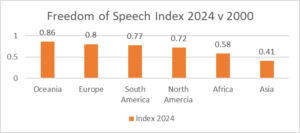
In producing the data, V-Dem poses the question: “To what extent does Government respect press and media freedom, the freedom of ordinary people to discuss political matters at home and in the public sphere, as well as the freedom of academic and cultural expression”? Their index is set on a scale of 0 to 1 from least free to most free. The data was last updated in March 2025.
What seems clear from the data, is the fact that globally the index has shown a downward trend between 2000 and 2024.
Interestingly, Africa has improved in this index albeit marginally.
Closer to home
The Freedom of Expression Index for the Eastern Africa region (bearing in mind this data is as at March 2025), shows some interesting comparisons although given what we see today, one would need to question the veracity of the data!
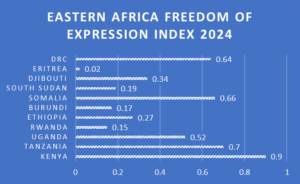
The index for Freedom of Expression estimates the extent to which “people can discuss political matters at home and in the public sphere, the press, and media are free and can present different political perspectives, and the freedom of academic and cultural expression”.
Freedom House, a Non-Governmental Organisation, founded in 1941 to “defend democracy worldwide”, carries out a Freedom in the World Survey which analyses “the electoral process, political pluralism and participation, the functioning of the government, freedom of expression and of belief, associational and organisational rights, the rule of law, and personal autonomy and individual rights”.
Kenya – Partially Free
“Kenya holds regular and competitive multiparty elections. However, pervasive corruption and brutality by security forces remain serious problems. While the country’s media and civil society sectors are vibrant, journalists and human rights defenders are vulnerable to restrictive laws and intimidation”. Freedom House overview on Kenya
Freedom of Expression in respect is enshrined in the country’s Constitution under Article 33. Article 37 allows for the right to assemble peacefully without fear of repression – the recent Gen Z uprisings probably indicate otherwise! The media is guaranteed freedom under Article 34. Kenya is rated as “Partially Free”. In its 2025 Freedom in the World score, Kenya was rated 51/100 down from 52/100 in the previous year.
The question “Are safeguards against official corruption strong and effective?”, scored 1/4 as did “Is there freedom of assembly?”. Both have been very evident in the recent Gen Z uprising. There were several other categories that had these low scores.
Tanzania – Not Free
“Tanzania has held regular multiparty elections since its transition from a One-Party State in the early 1990s, but the opposition remains weak. The ruling Chama Cha Mapinduzi (CCM) has retained power for over 60 years. H.E. Samia Suluhu Hassan became President in 2021 upon the death of President John Magufuli, who had cracked down on critics in the Opposition, media, and civil society. After a period of some liberalisation, President Hassan has begun to resort to similarly repressive tactics”. Freedom House overview on Tanzania
Freedom House rated Tanzania at 35/100 down from 36/100 in 2024. The abductions and resulting disappearance of anti-Government activists has played a large role in Tanzania’s relatively low score. The next review will probably see further deterioration given the recent banning of the main Opposition Party from participating in the October 2025 election.
In most categories and questions posed in carrying out this review, Tanzania scored a miserly 1/4. It can only be hoped that the gains on freedoms in the early years of President Hassan’s Administration will find their way back after the election.
Uganda – Not Free
While Uganda continues to hold regular elections, their credibility has deteriorated. The country has been ruled by the National Resistance Movement (NRM) and President Yoweri Museveni since 1986. The NRM retains power through patronage, intimidation, and politicised prosecutions of Opposition Leaders. Uganda’s civil society and media sectors face legal and extra-legal harassment and state violence”. Freedom House overview on Uganda
Uganda score is 34/100 in 2025 with no change from 2024.
The country’s Anti-LGBTQ law played a role in the Not Free rating as did the arrest and subsequent mistreatment of Opposition Leader, Dr. Kizza Besigye, who remains in detention pending trial. Uganda too has most ratings as 1/4 which given these two positions by the Government, is hardly surprising. A considerable amount of work will be required to improve the country’s rating.
Ethiopia – Not Free
The 2018 election of Prime Minister Abiy Ahmed initially set off a transitional period. Abiy pledged to reform Ethiopia’s authoritarian state, undertook legislative reforms, held elections, and implemented some liberalisation policies. However, Ethiopia remains beset by internal conflicts and intercommunal violence; abuses by security forces and violations of due process are common, many reformed laws have yet to be implemented meaningfully; and many restrictive laws remain in force. Armed conflicts in the Amhara, Oromia, and Tigray regions in recent years have caused widespread displacement, and credible allegations of atrocity crimes have emerged”. Freedom House overview on Ethiopia
Ethiopia scored 18/100 in 2025 down from 20/100 in the previous year.
The conflicts in the country continued to disrupt Ethiopia and the scale of destruction, looting and displacement of the population did not help. In the regions where the conflicts prevail, there have been numerous reports of media personnel and others being kidnapped for ransom. Development in Addis Ababa resulted in the displacement of many people. Indeed, the Ethiopian Human Rights Defenders Center said: “escalating pressure on journalists, including arbitrary arrests, intimidation, threats, and forced self-censorship”. There has, apparently, also been suspension of several NGOs in Ethiopia.
Rwanda – Not Free
The Rwandan Patriotic Front (RPF), led by President Paul Kagame, has ruled the country since it ousted forces responsible for the 1994 genocide, ending the civil war that began in 1990. While the regime has maintained stability and economic growth, the Government continues to suppress political dissent through pervasive surveillance, intimidation, arbitrary detention, torture, and renditions or suspected assassinations of exiled dissidents”. Freedom House overview on Rwanda
Rwanda scored 21/100 down from 23/100 in 2024.
In July 2024, President Kagame won a further term as the President winning 99.2% of the vote. Freedom House comments that two Opposition Leaders were disqualified from running. The Ruling Party also won a majority in Parliament. Concern has been raised in the review of Rwanda’s support of the M23 Rebels, which has consistently been refuted by the Government. Rwanda scored 0/4 on many of the questions posed in the review and, indeed, had no scores above 2/4.
Other countries in Eastern Africa
The other countries in the region were rated as:
| Country | Rating | 2025 Score | 2024 Score |
| Burundi | Not Free | 14/100 | 14/100 |
| Djibouti | Not Free | 24/100 | 24/100 |
| DRC | Not Free | 18/100 | 19/100 |
| Eritrea | Not Free | 3/100 | 3/100 |
| Somalia | Not Free | 8/100 | 8/100 |
| South Sudan | Not Free | 1/100 | 1/100 |
Conclusion
It is apparent that the world is experiencing less Freedom of Expression when comparing the turn of the century to today. In Eastern Africa, all the countries are rated as Not Free except for Kenya, which is classed as Partially Free. As matters currently stand in the region, this is unlikely to change in the foreseeable future.
This is a commentary and comments are welcome by email to: info@eaa.co.ke . The views expressed here are not necessarily those of the Association.