

This is a commentary and comments are welcome by email to: info@eaa.co.ke . The views expressed here are not necessarily those of the Association.
POPULATION TRENDS
Where are we headed?
The United Nations, in its 2024 Revison of World Poulation Prospects, projected the global poulation to approach 8.2 billion people in 2025 climbing to 10.2 billion by the year 2100:
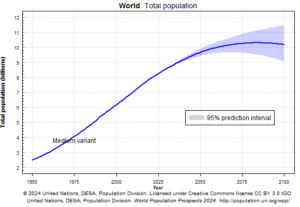
The rate of growth is declining and according to the review, it will be negative between 2075 and 2100, peaking at 10.3 billion in the 2080s, and declining thereafter. Earlier projections have been revised downwards by approximately 6% largely attributed to “lower than expected fertility rates” in many of the world’s largest countries with China being the major contributor to the decline.
The UN cites an 80% probability that the world’s population will reach its peak in this century. Indeed, at least 63 countries or areas, including Germany, Japan, the Russian Federation and China, have already peaked and are expected to decline by “14% over the next 30 years”. These countries represent 28% of the global population. It is projected that 48 countries or areas, representing 10% of the global population are expected to reach their peak size between 2025 and 2054. However, 126 countries are expected to grow by 38% through to 2054.
What seems clear is that the world is facing declining fertility rates having dropped from 3.31 live births per woman in 1990 to 2.25 in 2024. In 20% of countries, live births have fallen to 1.4 per woman – a substantial reduction. Conversely, life expectancy in 2024 was 73.3 years compared to 64.9 in 1995. It is projected that by the late 2050’s, life expectancy is expected to be over 80 years. Incidentally, the women amongst us, have and will continue to, live longer than the men!
Age demographics
The UN projects that 100 countries will see an increase in “working age population” until 2054. While this could lead to substantial economic growth for these countries, much will depend on Government policies that support growth – something that has certainly been lacking in many parts of the world. In particular these countries will have to concentrate on education, health, infrastructure, technology and of course AI.
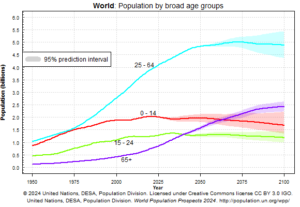
Perhaps, a more interesting projection by the UN, is that by 2080, the population aged over 65 will outnumber those under 18. This development may happen sooner for countries where the population has already peaked. The focus will now have to switch to “technology, lifelong technology and support for older workers”. In many parts of the world, Government social protection for the aged is becoming increasingly burdensome.
The current youth bulge was discussed extensively at the World Economic Forum (WEF) in January 2025. A report entitled “Global Shapers Impact Report” was issued and commented: “With half the world’s population under 30, young people hold the key to our shared future. The good news is they are driven by optimism and resilience despite unprecedented economic, social and environmental challenges”. In response, according to the WEF: “businesses, governments, and organisations should invest far more in the younger generation’s creativity and talent”.
The general belief has always been that the youth of today are not interested in politics around them, but a survey of 4,000 people aged between 18 and 30 years of age conducted for the report, suggests otherwise. With the largest population demographic ever, the report found that 83% of them believe there are opportunities galore and nearly three-quarters of those surveyed are acting on issues that they feel directly impact them. Interestingly, 68% of those surveyed want to be the leaders of the future and 50% are convinced they can shape decision-making in their respective countries and the world as a whole. Indeed, the Kenyan Gen Z Movement is actually pushing for change both in their lives and the political scene around them.
“This does not mean they view the world through rose-tinted glasses. They are acutely aware of the persistent challenges stacking up around them, with a lack of economic opportunities viewed as the top problem in their communities, alongside environmental crises and government inaction”. Global Shapers Impact Report, WEF 2025
Key for the youth today is the scarcity of economic opportunities for them which has resulted in high levels of unemployment. That said, according to the WEF, youth unemployment globally has fallen to 13%, the lowest in the past 15 years and is expected to fall further to 12.8% in 2025. This is perhaps the most critical area that Governments must focus on if they are to appease the 18 to 30 year-olds. This issue is vital globally and certainly in the Eastern African region and other lower income countries. Sadly, the jobs that are available do not match the education qualifications of this age group.
Apart from economic opportunities, today’s youth are extremely aware of the impact of “Climate Change, armed conflict, involuntary migration and lack of basic welfare”.
The issues that the youth face has resulted in more involvement in politics by them, perhaps, to ensure that governance is coming from people who understand their plight. There is a long way to go with the Inter-Parliamentary Union saying that “only 2.8% of Parliamentarians are aged 30 or under”. Given that the under 30-year-old population will be the most impacted by legislative and policy changes made today well into the future, it is perhaps time for them to be involved in these decisions. What is quite clear is that most world leaders today are completely out of touch with the needs of the youngest sections of their populations.
The WEF points to 5 areas which Governments, business and Civil Society must address for the benefit of the youth:
- Engage them in issues they care about most.
- Provide sustained funding and resources for the youth to thrive.
- Let them be involved in the decision making that will impact their future.
- Training the youth and equipping them with the tools to be the future leaders.
- Recognise that the youth have “insights and solutions” to shape the future.
Of course, this may be easier said than done, but there is no doubt it is a key imperative for the future.
Closer to home – a look at the major Eastern Africa economies
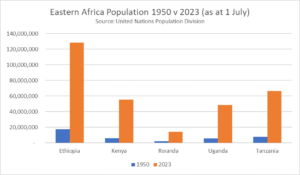
The chart above depicts the change in population in Eastern Africa as at 1st July 1950 and 1st July 2023. There has been a significant jump during the 73-year time span and this has increased further since 2023 and is expected to continue well into the future. Similar trends are evident in the smaller economies. What does seem clear though, when we look at the increased poverty levels in these countries over the years, is that Government policies have not kept pace with the growth, and key areas of education, health and social welfare have declined. Much of this can be attributed to poor governance and, of course, increased levels of corruption.
The table below provides an interesting finding by the UN on how long it will take for the population in the region to double. There appears to be a clear message here that the region’s Governments will have their work cut out to cope with the significant rise in population over the next 30 years. Indeed, when compared to the world as a whole, Africa and the region’s population double approximately twice as fast, which can be both an advantage and disadvantage.
| Region | Years for population to double |
| Ethiopia | 26.8 |
| Kenya | 35.1 |
| Rwanda | 31.8 |
| Uganda | 25.0 |
| Tanzania | 24.0 |
| Africa | 29.9 |
| World | 79.6 |
| Source: United Nations World Population Prospects 2024 | |
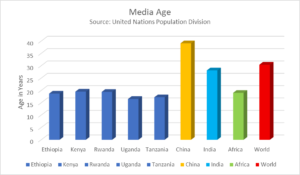
The youth bulge in Eastern Africa, and indeed the rest of Africa, is another striking indicator of where the world is headed. The Continent clearly has a young population that needs to be provided for and listened to when crafting policies for the future, not to mention the huge economic potential. Even the two countries with the largest populations have a significantly higher median age.
The future
The world’s population has now crossed 8.2 billion people but the rate of growth, other than in Africa, seems to be trending downwards. The UN projects that the global population will be in the region of 10.2 billion people in 2100. For Africa, including Eastern Africa, populations will double over the next 30 years and with a largely young population, Governments will need to refocus their priorities and policies for the future. The question is: does the Continent have the necessary political will to address this? Current indications show that it probably does not!
But global fertility rates are on the decline in at least 70 countries around the world, according to the World Population Review Newsletter issued on 23rd August 2025. Indeed, the global fertility rate is now at 2.3 compared to 5.0 in 1950 – it has dropped by over half. The developed world is showing the biggest decline which the newsletter says is “driven by rising education, urbanisation, and the rising costs of housing and childcare”. Tanzania and the DRC are bucking the trend of declining fertility rates and in excess of 50% of their population is under 18. The newsletter project: “Future shift: by 2100, over 1 in 3 people will live in Africa – up from 1 in 6 today”.
“Unexpected reality: Japan now sells more adult diapers than baby ones – proof that population aging isn’t theoretical. It’s here”. World Population Review Newsletter 23rd August 2025
Population demographics are changing rapidly – indeed, by 2050 China’s will have twice as many people over 65 as under 15! Africa is likely to have the youngest population globally, but it is evident the Continent is not planning for the future and time is running out.
This is a commentary and comments are welcome by email to: info@eaa.co.ke . The views expressed here are not necessarily those of the Association.