
This is a commentary and comments are welcome by email to: info@eaa.co.ke . The views expressed here are not necessarily those of the Association.
CORRUPTION AND WHAT IT DOES
Background
“Corruption is an evolving global threat that does far more than undermine development – it is a key cause of declining democracy, instability and human rights violations. The international community and every nation must make tackling corruption a top and long-term priority. This is crucial to pushing back against authoritarianism and securing a peaceful, free and sustainable world. The dangerous trends revealed in this year’s Corruption Perceptions Index highlight the need to follow through with concrete action now to address global corruption”. François Valérian, Chair of Transparency International, 2024 Corruption Perception Index
In February 2025, Transparency International (TI) released its Annual Report – Corruption Perceptions Index – for 2024. The organisation will issue the 2025 report early next year, so while the 2024 data maybe somewhat dated, it is perhaps useful to see where the world was as regards to corruption last year. Once the 2025 report is issued, the Association will write an update comparing the two years.
Cornell University provides a legal definition: “Corruption is the dishonest, fraudulent, or criminal use of entrusted authority or power for personal gain or other unlawful or unethical benefits. Corruption occurs in politics, business, education, media, and other social and economic fields”. TI defines corruption as “the abuse of entrusted power private gain”. They rank corruption as one of two of the biggest challenges the world faces, the other being Climate Change.
Corruption has many guises and a quick search on ChatGPT points to corruption by scale (petty, grand or systemic), nature (bribery, embezzlement, fraud, extortion, nepotism and cronyism, abuse of power, or conflict of interest), by sector (public, private, or political), and by transaction type (transactional or relationship based). Clearly these are not new and one comes across them either directly or indirectly on an almost daily basis, depending on where one is in the world.
The TI Corruption Perception Index covers 180 countries. The organisation uses a fairly complex methodology with data from 13 different sources which can be found at and analysed using 20212 as the benchmark which is then scored over 100:
https://www.transparency.de/fileadmin/Redaktion/CPI2024_SourceDescription.pdf?utm_source=chatgpt.com.
In the 2024 reports, TI reports that over two thirds (67.8%) of the countries around the world rank below 50. The comparative for 2023 was 66.7% so there has been a marginal increase year-on-year.
The least corrupt
Between 2024 and 2023 there has been little change in the top 20 least countries in the world with Denmark and Finland leading the pack in both years. Other countries have moved up or down at the top. This is not something new as all the countries at the top end of the list have remained there for a number of years!
The most corrupt
Here too the bottom of the rankings in the 2 years is largely the same with the same culprits! Several of the countries at the bottom are in Sub-Saharan Africa which, as it did in 2023, has the lowest average score. Indeed in 2024, 90% of the area scored below 50 compared to a global average of 67.8%, although the report does acknowledge that some countries have “invested in anti-corruption and made remarkable progress”. In particular, Cote d’Ivoire has gained 13 points since 2015, Seychelles 20 points since 2012, Tanzania gaining 11 points since 2015, Angola 17 points since 2015 and Zambia 6 points since 2020. The largest drop in score was seen in Lesotho, Eswatini, Gabon and Liberia.
Closer to home
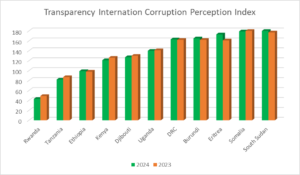
Scores in Eastern Africa have remained roughly the same between 2024 and 2023.
Rwanda is clearly the outlier in the region coming in the top 50 in both years with improvement between 2024 and 2023. On the other hand, Somalia and South Sudan languish at the bottom of the table in both years! This trend has not changed for many years.
What is the impact of corruption?
Corruption has a marked impact on a county’s social capital, the youth, destroys trust in Governments and of course fuels political instability, among others. In developing countries, corruption has, and will no doubt continue to, impact poverty levels and the general availability of public services.
In June 2023, the World Economic Forum published an oped in French La Tribune Africa saying: “Corruption harms the poor and vulnerable the most, increasing costs and reducing access to basic services, such as health, education, social programs, and even justice. It exacerbates inequality and reduces private sector investment to the detriment of markets, job opportunities, and economies”. For those of that live and work in Eastern Africa this impact is seen on a daily basis and has a marked effect on our daily lives.
But can one measure the true cost of corruption on an economy? According to the UN while this is difficult, it is not necessarily impossible. Indeed, as long as go as 2016 the IMF estimated that “the cost of bribery alone” amounted to USD 1.5 to USD 2 trillion a year, which did not include fraud, money laundering and tax evasion! A staggering number which they went on to say was 2% of global GDP. The World Bank, in 2019, said that in Nigeria, an oil rich country, over 50% of the population lives in abject poverty as a direct result of corruption and in particular bribery.
As a result of corruption, an economy often becomes inefficient as competition is reduced by the clearly more competent people and companies being awarded large contracts. In the developing world a major impact of this practice is under development which has a direct effect on public services and the less privileged in the countries. Again, those living in such countries see this impact first hand. The UN has said: “Under conditions of corruption, funding for education, health care, poverty relief, and elections and political parties’ operating expenses can become a source of personal enrichment for party officials, bureaucrats and contractors”.
“What is described as dysfunctional above is actually functional and profitable for corrupt actors. Whether falling under the label of political cronyism, crony capitalism, political party cartels, oligarchy, plutocracy and even kleptocracy, widespread patterns of private and public corruption construct social systems that are rigged in the private interest”. United Nations Office on Drugs and Crime – University Module Series
In all cases, the people that suffer are the general population who are having to grease palms to obtain basic services that are often included as a right in a country’s Constitution. The beneficiaries – more often than not politicians, civil servants, tax authorities, police and armed forces – are always happy and can be seen flaunting their illicit wealth with expensive houses, cars and personal belongings, and are rarely brought to book for their economic crimes. It is indeed quite rare to see someone prosecuted in most parts of Eastern Africa for such crimes because political nepotism prevails. The TI Corruption Perception Index quite clearly shows which parts of the world suffer from this dilemma.
Do corruption levels impact a country’s population’s behaviour?
History is littered with examples of a popular uprising bringing about a change in Government but it does seem to be happening with increasing regularity now.
In 2019 there were several countries in the world that saw protests that were commonly known as the “Arab Spring”. There were at least 14 such protests around the world which in 4 cases resulted in the sitting Government being overthrown. The others saw widespread protests that resulted in some concessions being given by the Government.
More recently, the world saw Governments in Nepal, Sri Lanka, Bangladesh and Madagascar being overthrown by street protests. The common thread in all 4 of these countries – a population that was frustrated with their leaders and in particular the large-scale corruption that was taking place to the detriment of the citizens.
Interestingly, in the 2024 TI Corruption Perception Index, each of these countries appeared in the bottom half of the rankings, with Nepal at 107, Bangladesh at 151, Madagascar at 140, and Sri Lanka (the Government was overthrown in 2022) at 121. In all cases it was the countries youth, many of whom were unemployed, that instigated the protests. While overthrowing an unpopular and often Government may well be seen as a good thing, in all cases the new Governments are probably not much better.
In Indonesia (TI ranking 99), similar protests, but more about the high cost of living, saw the country’s President make changes in economic policy and in some Ministries. Closer to home, the 2024 Gen Z uprising in Kenya saw the Finance Bill 2024 not being assented to and the entire Cabinet being reshuffled with at least 50% of it being replaced.
The future
What seems clear is that the youth of today are not prepared to sit around ideally while they witness grand corruption benefitting a small part of the country largely the politicians. Recently the population in Tanzania were on the streets during the elections, which did not result in any significant change as President Hassan was “re-elected”, a result which was not really in doubt anyway.
Citizen uprising driven by unpopular Government policies and excessive corruption, are likely to be more common in the coming months and years. We are also seeing demonstrations in the developed world ranging from immigration policies, poor public services, high unemployment, and a generally discontent population.
Corruption is a game of give and take – where there are givers there will always be takers. Stamping the phenomena out is not going to be easy and will require a large-scale cultural change. We are already seeing exposure of corrupt activities as information flow becomes easier. Unfortunately, what we are not seeing is any action being taken where corruption is exposed. What is required is some public prosecutions that result in convictions and serious jail time and prison terms.
But this is probably easier said than done!
This is a commentary and comments are welcome by email to: info@eaa.co.ke . The views expressed here are not necessarily those of the Association.