
This is a commentary and comments are welcome by email to: info@eaa.co.ke . The views expressed here are not necessarily those of the Association.
EASTERN AFRICA DEBT
Debt levels on the rise
|
“Debt is like any other trap, easy enough to get into, but hard enough to get out of”. Henry Wheeler Shaw (1818 – 1885) |
What Henry Wheeler Shaw said in the 1800s very aptly describes what the Eastern Africa region is facing today. The entire region is seeing rising debt levels with some countries handling it better than others.
Of course, debt in itself is not a bad thing. The issue comes when countries borrow for a particular reason but use the funds for a different purpose – typically using debt for infrastructure development to finance recurrent expenditure. Most of the Eastern African countries are seeing an increase in debt levels but no similar growth in revenues. And herein lies the debt trap!
Unfortunately for the region, the current state of global geopolitics, is putting further pressure on revenue collections, and while some countries are coping better, in the long run all these countries may feel the pinch.
Tax revenue as a percentage of GDP
The IMF has a benchmark of 15% for Tax:GDP and none of the above countries, with the exception of Rwanda (15.5%), are currently meeting this. Indeed, Rwanda is targeting 17% by 2029/30. Kenya’s ratio ranges between 13.5% to 14.5% and has been showing a downward trend since 2014. Uganda is at 13.4%, while Tanzania ranges between 11% and 12%. Ethiopia has a ratio of 9.1% rising from 6.2% in 2023/24 but at 12.4% in 2014/15.
International rating agencies scores
The three major international rating agencies rate the Eastern African countries as speculative (high risk) ranging from B to Caa/CCC. This level of rating borders on what would typically be classified as “junk”. To put this in perspective, only three African countries are classified as having an investment grade rating – Botswana, Mauritius, and Morocco.
The table below sets out the most current ratings by each of the agencies:
| Country | Moody’s | Fitch | S&P Global |
| Kenya | B3 | B- | B |
| Tanzania | B1 | B+ | Not rated |
| Uganda | B2 | B+ | B- |
| Rwanda | B2 | B+ | B+/B |
| Ethiopia | Caa | RD (Restricted Default) | CCC+/C |
Kenya
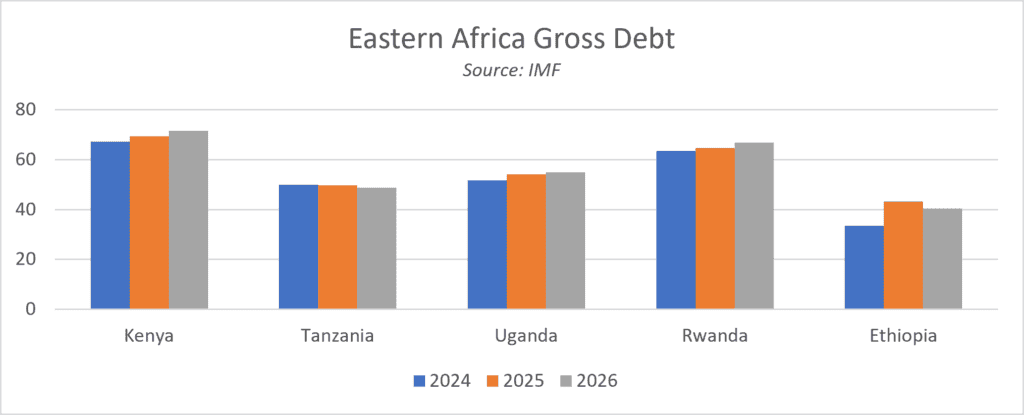
By the middle of 2026, Kenya’s debt was estimated as being KES 13 trillion (USD 100.5 billion) which significantly exceeds the limit of 55% that is set out in the country’s Public Finance Management Amendment Act 2023, although the Act does allow the Government up to 2028 to be at this level. The current increases in borrowing by Kenya, certainly make it seem unlikely that they will meet the limit.
Kenya Wall Street say: “Kenya also exceeds the IMF’s 50% developing country threshold and the EAC’s 50% convergence target. External debt eases to 29.0% of GDP in 2026, with import cover at 4.9 months”. The highest debt to GDP ratio was seen in 2023 at 73.4% but this fell in 2024 due to the strengthening of the currency.
Of the total debt, 56% represent domestic borrowing and 44% external. The IMF in their April 2026 Regional Outlook projected that debt to GDP will climb to 71.6% during the current year and increase further to 72.4% in 2027. Clearly, this level of debt is probably not sustainable in the medium to long term.
The shift to domestic debt is in keeping up with the country’s 2025 Medium-term Debt Strategy as a move to protect the country from Foreign Exchange fluctuations. That said, the Kenya Shilling has been remarkably resilient in the last two or so years staying between KES 128 to KES 130 against the US Dollar. As reported previously, Kenya converted two of its US Dollar loans to the Chinese Yuan last year.
However, the move into domestic debt has a significant consequence for private sector credit as the financial sector lends more to the Government. According to the Africa Finance Corporation, as reported by the Star Newspaper, “uncontrolled domestic borrowing by African Governments chokes capital markets, crowding out vital infrastructure investment”.
The Government is spending as much as 60%, and possibly more, of its revenues in some months to service debt. The IMF recommends that debt servicing should not be more than 30% and Kenya’s current levels are creating a “fiscal trap”. Indeed, CNBC reports that: “Moody’s Investors Service notes that Kenya retains one of the highest debt interest-to-revenue ratios globally, spending over a third of its budget purely on domestic interest payouts”. Regionally, Kenya’s debt servicing is nearly double that of other countries.
With this level of debt servicing and coupling it with high Government expenditure – which despite commitments does not seem to be falling – the country does not really have the room for development spending. In fact, as more is borrowed and with schemes in place to securitise some Government levies, the country is very much in the “debt trap” region.
Tanzania
|
“To address the challenges that have emerged, the Ministry has continued to take various measures. First, strengthening systems and expanding the scope of domestic revenue collection. Second, increasing borrowing from the domestic financial market following the positive performance of government bond and securities auctions”. Tanzania Finance Minister in presenting the Budget proposals |
Tanzania is perhaps the most disciplined in the region when it comes to debt with the ratio to GDP being below 50%. The country’s debt as at the end of March this year was TSH 114 trillion (USD 43 billion) spilt two-thirds in external and one-third in domestic. Domestic debt has been rising (approximately 27% in 2020) in a bid to hedge against Foreign Exchange risk.
The external debt comprises 61% from multilateral sources, 12% from bilateral, and 27% from commercial and other sources. The proportion of multilateral debt (with the World Bank being the largest source) means much of the external borrowing is at concessional rates. Bilateral debt is predominantly now from China and India under export-import credits for infrastructure. Commercial borrowing is being used for major projects such as transport and energy.
The shift to increase domestic borrowing could, in the long run, result in crowding out the private sector, but as it currently stands, it is well within targets. On the other hand, the larger proportion of external borrowing does present a Foreign Exchange risk which the country experienced between 2023 and 2025 resulting in an increase in the debt by TSH 8.5 trillion (USD 3.2 billion).
Uganda
Uganda’s public debt is currently at approximately UGX 126 trillion (USD 35 billion) of which 55% is domestic and 45% external. Much like other countries in the region, the country’s Central Bank is relying more heavily on domestic debt to protect against Foreign Exchange risk. Indeed, in November 2024, the Ugandan Government said that they would reduce foreign debt in the Financial Year 2025/2026. This does not appear to have been achieved. Current downgrades in ratings have also led to a plan to reduce foreign borrowing.
The country’s external debt comprises between 56% to 64% from multilateral funders, 24% to 27% from bilateral, 10% to 19% from commercial sources, and between 4% to 10% from investors in Government securities.
As with other countries, the move to more domestic borrowing may well put pressure on private sector credit. However, Uganda’s economic growth has been above average and is expected to grow further with the country’s oil reserves and increased gold exports. As Uganda moves into commercial oil production, it is expected that local borrowing will reduce with the revenues coming in and external debt will be easier to service as the country’s credit risk improves. Ultimately oil revenues will also change the composition of Uganda’s external debt with more coming from concessional loans. A Petroleum Revenue Investment Reserve is already planned.
Rwanda
Debt in Rwanda has increased substantially in the last few years, particularly post Covid-19, with the total amount now in the region of USD 13.05 billion. Between 77% and 80% of the debt is external but of this, it is estimated that 87% is in the form of concessional loans. With 80% of Rwanda’s debt being denominated in Foreign Currency, a stable currency is essential. Unfortunately, the Rwandan Franc has depreciated by 16.3% and 9.68% in the Financial Years ending 30th June 2024 and 2025. On a more positive note, the rate of depreciation in the first half of 2026 is significantly lower.
The country has consistently had both current account and trade deficits, although the latter has narrowed in the recent past. The IMF, in early 2026, provided financing of USD 250 million which allowed the country’s Central Bank the opportunity to more effectively manage the exchange rate. Also in early 2026, Fitch revised its outlook for Rwanda from Negative to Stable.
Rwanda’s Second National Strategy for Transformation (NST2), is the key development platform for the country up to 2029. The focus is on “economic transformation, social transformation and transformational governance” according the Ministry of Finance and this has been included in its recent Budget. The financing for this is expected from domestic resources, expansion of private sector capital, and structured international partnerships. This approach seems to be more inclusive and does not envisage development through debt alone.
The Institute of International Finance has issued its 2026 Investor Relations and Debt Transparency Report which ranks Rwanda as one of the top performers given its transparency on public debt.
Ethiopia
Ethiopia debt stands at approximately USD 52 billion which is 45.3% of GDP being one of the lowest in the region. 65% of its debt is from external sources – primarily from the Paris Club and China – and the balance domestic. In late 2023, the country defaulted on its USD 1 billion Eurobond and while discussions are ongoing, the matter was heading to the to Courts in the UK. However, it appears an agreement in principle was reached at the end of June under which the country would issue a new bond of USD 880 million at an interest rate of 6.15%, repayable by July 2029 in instalments. In addition, Ethiopia will pay USD 99.4 million for the default amounts. In addition, the bondholders will be provided warrants allowing participation in any future bonds.
Following the deal, the IMF approved a disbursement of USD 464 million under the Extended Credit Facility. A total of USD 2.65 billion has been disbursed under this facility to date. Despite this, the IMF-World Bank Debt Sustainability Analysis rates Ethiopia’s debt as “unsustainable based on the pre-restructuring debt service schedule, mainly due to protracted breaches of exports-related external debt indicators and is based on a weak Debt Carrying Capacity (DCC)”. The Government is committed to moving this rating to “moderate risk of debt distress”.
It seems clear that the country is taking the necessary action to achieve this. Immediately prior to the IMF decision, the Ethiopian Government through its Monetary Policy Committee, announced “the complete removal of the commercial bank credit cap and a transition toward indirect monetary policy tools”. This was one of the outstanding points mentioned by the IMF in approving the recent disbursement and comes 5 months earlier than the original planned date.
Clearly, Ethiopia is heading in the right direction in managing its debt.
Conclusion
At the end of the day there is nothing wrong with having debt provided it can be serviced, and is used for the purpose it was borrowed for. The Eastern Africa region is seeing a rapid increase in debt and arguably, not all countries are faring well. The temptation to finance everything by way of debt is likely to have long-term consequences – in effect, the countries are creating mortgages for future generations!
For the region, it is critical that countries bear this in mind. They also need to look at expanding their revenue collections and contracting their expenditure, despite how politically unbearable this might be.
The table below shows the debt distress rating of the five countries by the IMF-World Bank Debt Sustainability Analysis and this needs to be borne in mind by the various Governments:
| Country | |
| Kenya | High |
| Tanzania | Moderate |
| Uganda | Moderate |
| Rwanda | Moderate |
| Ethiopia | Unsustainable and in distress |
Whereas the others seem to be on the right track, Kenya and Ethiopia need to be careful.
This is a commentary and comments are welcome by email to: info@eaa.co.ke . The views expressed here are not necessarily those of the Association.