
How finance, trade, energy, and geopolitics now dictate who gets funded.
 .
.
In an era where global capital no longer moves freely but navigates a maze of shifting alliances, export controls, currency restrictions, and political entanglements, the very foundations of investment have been reshaped not gradually or rhetorically, but through a series of sharp breaks that have fractured the once-consensual model of globalisation.
East Africa, like many frontier regions, sits at the crossroads of this fragmentation. The region’s exposure to global capital is now inseparable from its positioning within a world that has become more transactional, more contested, and far less predictable than the frameworks it inherited. Countries are being judged not only by their macro fundamentals or growth potential, but by their ability to maintain regulatory credibility under stress, to deliver infrastructure without delay, and to create investable pathways that can withstand not just attract capital.
In this context, the language of competitiveness must evolve. Cost arbitrage and demographic advantage, once reliable signals, are no longer sufficient to command interest from investors who now price risk with far greater discipline, and who increasingly view capital deployment as a matter of geopolitical alignment as much as economic return. What matters is not simply whether a project meets a market need, but whether the underlying structures legal, financial, and political can survive uncertainty without eroding trust or delaying execution.
Energy security, resilient logistics, access to strategic inputs, digital sovereignty these have moved from the margins of policy to the centre of investment decision-making. East Africa’s potential remains undeniable, but the mechanism by which it becomes competitive, in this new global order, will depend less on pitch and more on preparation. The story is no longer about promise; it is about precision.
This paper sets out how East African markets if structured properly can move from being perpetual candidates for investment to credible partners in capital formation. It focuses not on macro narratives but on the granular building blocks that now define investability: policy that can be enforced; pipelines that are genuinely prepared; and financial structures that do not sidestep currency and political risk, but confront them directly through design.
According to the UNCTAD report, FDI globally in 2024 was at around $1.5 trillion. The top line gaffles: much of the jump is caused by volatile conduit flows in certain corners of Europe, but the picture looks different if you see the money all the way from Europe economies to sub-Saharan African economies. As a bloc, the latter saw record inflows of $97 billion the previous year, which translates as six percent of FDI globally; if a mega-project one-year effect is removed, the continent still grew by double digits. In this, part of the East Africa attracted $12.7 billion, rising around twelve percent year on year. Ethiopia attracted $4.0 billion, Democratic Republic of the Congo attracted $3.1 billion, Rwanda attracted $0.8 billion and Mauritius attracted $0.7 billion; together, these four economies accounted for nearly 68% of sub-regional inflows. Even as momentum gets building up, it has been patchy and largely unforeseen, and jurisdictions are being rewarded for providing clarity and depth.
https://unctad.org/system/files/official-document/wir2025_annex-tables_en.pdf
”Follow the flows: East Africa’s FDI rose to $12.7 billion in 2024, with Ethiopia and the DRC setting the pace.”
Returns and risk: The equation is shifting
Investors haven’t lowered their sights on returns, but what has changed dramatically is their threshold for ambiguity. Fuzzy rules, fragile contracts, and currency terms that seem deliberately opaque are no longer tolerable. The old days of brushing off risk with a handshake and a smile have given way to a far more meticulous era, one in which scrutiny is of great importance.
Due diligence has moved well beyond market sizing and unit economics. The real questions now begin with enforcement. Can contracts hold across political cycles? Is foreign exchange truly convertible, or does it come with strings no one discloses upfront? Will profits make it home, or get stuck in the bureaucratic plumbing of a central bank?
These requirement go beyond your tick box compliance checks, they have become the gating items. And the global system is beginning to adjust. In 2024, the World Bank Group launched a unified Guarantees Platform, a departure from fragmented legacy tools that too often created more friction than confidence. The new ambition is to mobilise $20 billion annually in guarantees by 2030. It’s a significant number, but more than that, it signals a serious shift in posture toward longer tenors, deeper coverage, and political-risk protection that makes capital stay longer and travel farther.
In parallel, the once-clunky world of cross-border payments is being rewired. Real-time settlement platforms are quietly transforming trade finance. Letters of credit that used to take days can now be confirmed in hours. Cash flow cycles, once highly unpredictable, are gaining structure and rhythm. For investors, this not only lowers the cost of capital but also widens the pool of institutions able and willing to participate.
Returns and risk: Rewriting the investment compact
Investor expectations haven’t softened, but what has shifted irreversibly, is the willingness to absorb ambiguity. Rules that bend under pressure, contracts written in disappearing ink, and currency regimes that operate more like bureaucratic mazes than functioning markets no longer pass muster. The informal tolerances of the past have given way to a far more disciplined model, one where capital is contingent not just on promise but on precision.
Due diligence, once largely a function of market sizing and cost curves, has matured into something more forensic. Investors no longer ask whether a market is growing they ask whether it is governable. They want to know whether contract enforcement survives the political cycle, whether foreign exchange markets are both liquid and accessible, and whether capital repatriation is a legal right or a discretionary favour. These aren’t secondary considerations; they are the architecture upon which commitments are either built or abandoned.
In response, global institutions are recalibrating. The World Bank Group’s 2024 consolidation of its guarantee offerings into a unified platform was more than a branding exercise. It signalled a strategic pivot toward scale, coherence, and usability. With $20 billion in annual guarantees targeted by 2030, the message is clear: political-risk insurance and credit enhancement are no longer peripheral—they are now core to enabling long-dated investment in emerging economies.
At the same time, the once-invisible plumbing of cross-border finance is being reengineered in ways that matter. Real-time settlement systems are steadily replacing the legacy infrastructure that kept working capital trapped and trade finance out of reach. Letters of credit are becoming easier to confirm, friction is being reduced in daily liquidity flows, and, crucially, predictability is returning to cycles that once ran on guesswork. This quiet technical shift carries outsized implications: it lowers total financing costs, expands the pool of eligible financiers, and allows structured capital to flow not just where opportunity exists, but where systems are ready to absorb it.
This is not about de-risking the region into bland uniformity. It is about distinguishing investable environments from aspirational ones by addressing the structural deficits that have long distorted the price of capital and constrained its reach.
Energy: The foundational test of credibility
Nowhere is this more visible than in energy. It is the sector where investment narratives either harden into transactions or collapse under their own weight. A reliable grid, a transparent tariff regime, and institutions capable of delivering not just announcing reforms remain the minimum entry requirements for serious capital. No industrial ambition, however well-articulated, can withstand a power system that is intermittent, overpriced, or politically unstable.
In recent years, however, a number of East African markets have begun to cross the line from potential to preparedness. Utilities are shedding losses not only through operational improvements but through governance models that clarify accountability and limit political interference. Availability-based concessions are allocating risk in ways that lenders can underwrite, and tariff-setting formulas are increasingly balancing the tension between affordability and cost recovery, with provisions that reflect hard currency obligations rather than wishful local assumptions.
These adjustments go to the heart of whether capital can take a long view. Where policy frameworks are enforceable and revenue structures are predictable, risk-sharing instruments partial-credit and partial-risk guarantees, insurance wraps, liquidity facilities begin to function as intended. Long-term lenders, who previously stayed on the sidelines due to unhedged sovereign exposure, are re-engaging, not because the underlying risks have disappeared, but because those risks are finally being defined, priced, and, crucially, managed.
Yet it is not the installed capacity on paper that secures capital. What matters more is the resilience of the revenue stream behind it. Investors look for ring-fenced cash flows, step-in rights that can actually be executed, and offtake agreements that extend beyond political calendars. They interrogate the enforceability of contracts not only under current leadership but through transition and turbulence. The investors that matter most are not waiting for perfection, but they are demanding instruments and institutions that can withstand the shocks inherent to infrastructure finance.
Energy therefore is a litmus test for state capacity, for regulatory coherence, and for the seriousness with which a country intends to anchor private capital to long-term public outcomes.
Logistics: Where capital quietly compounds or erodes
It’s in logistics far more than headlines or policy announcements that the real cost of doing business is revealed. Capital doesn’t just chase opportunity; it responds to friction. And in much of East Africa, that friction resides not in macro indicators but in cargo that idles at port, paperwork that lingers at borders, and transport corridors that promise connectivity but deliver unpredictability.
Yet beneath the inefficiencies lies an opportunity that is neither flashy nor speculative: to build systems where movement is not just possible, but reliable. Predictable port throughput isn’t a metric for technocrats it’s a condition for trade finance. When containers clear in days instead of weeks, dwell times fall, demurrage costs evaporate, and working capital is freed for redeployment. Inland logistics from dry ports to rail lines can shift volume, but it is the procedural choke points at border crossings that often carry disproportionate cost. Harmonised axle-load regulations, one-stop border posts, and digitised customs clearance may seem like administrative tweaks, but they are, in practice, interventions that alter how lenders price risk.
The financial impact of this reliability is far-reaching, with trackable movement and enforceable timelines, structured trade finance begins to scale. Receivables securitisation long confined to pilot projects gains traction, no longer reliant on estimates but anchored in observable data. For agriprocessors, FMCG firms, and logistics operators, the conversation with financiers becomes fundamentally different. It is no longer about justifying exposure to risk; it is about demonstrating the compression of capital cycles, the shortening of inventory turns, and the stability of cash flows across time.
Ultimately, logistics is not just about moving goods. It is about moving capital through the system with confidence and speed, and the markets that recognise this are the ones that will find themselves on the right side of pricing.
Digital Infrastructure: Africa’s battleground for competitiveness
If energy is the foundation and logistics the circulatory system, then digital infrastructure is the nervous system of any investable economy. It determines not just who connects, but how capital interprets competitiveness in real time. And unlike other sectors, it is uncompromising in its requirements there is no such thing as halfway-ready when it comes to digital.
Data centres are only financeable where electricity is stable and power purchase agreements hold. Fibre networks only gain traction when spectrum policy is predictable and doesn’t shift with fiscal needs. Internet exchanges remain theoretical unless they are linked to real users and real transactions. And anchor tenants government, financial institutions, telecoms must exist not on paper, but in contracts that de-risk utilisation.
In markets where this clarity exists, so too do bankable models. We are seeing sponsors blend local-currency tranches often indexed to match revenue flows, not out of preference but necessity. Senior debt is being layered with political-risk insurance, not because it eliminates risk but because it helps institutional lenders quantify it. And increasingly, escrow waterfalls are being hardwired into structures to ensure that cash is not only collected, but protected and distributed according to agreed rules.
These aren’t abstract instruments; they are the mechanics of serious investment. Connectivity, in this framework, is no longer a public good to be subsidised indefinitely. It becomes an investable asset class with performance benchmarks, service-level guarantees, and contractual certainty. And in this asset class, capital moves quickly but only where policy is stable, institutions are capable, and execution can meet ambition without revision every fiscal year.
Agriculture and upstream resources cut across these themes. In agriculture, value capture depends on traceability, a cold chain and storage that meet importer standards, plus contractual offtake that shifts risk from speculative to bankable. Warehouse receipts and inventory‑backed facilities then move from pilot to platform. In minerals, the demand cycle for battery inputs remains supportive. Countries that pair high‑quality environmental and social safeguards with reliable power and efficient logistics from pit to port will capture more value onshore through responsible extraction and, where economic, early‑stage processing. The objective is not to chase every headline but to build a few platforms that compound.
”Depth beats breadth: a handful of credible platforms will do more for cost of capital than a long list of intentions”
For global investors, commitment now turns on five practical tests. The first is policy credibility, evidenced by procurement that works in practice and dispute resolution that survives political transitions. The second is currency and convertibility: usable hedging markets, clear prioritisation for foreign‑exchange allocation and predictable rules for profit repatriation. The third is revenue certainty: bankable offtake, cash‑flow ring‑fencing and step‑in rights that are actually exercisable. The fourth is preparation discipline: feasibility, environmental and social baselines, land and permits completed to international standards before capital is asked to commit. The fifth is local depth: utilities, banks and operators with the capability and balance‑sheets to share execution risk. Where these tests are met, pricing tightens and tenor extends; where they are not, investment committees hesitate, however compelling the macro story may be.
Across East Africa, the entry points differ, but the investable logic aligns. Ethiopia combines an industrial base with power potential and a growing export platform. Rwanda offers policy execution and service depth that compress decision times for corporate expansion. The DRC remains central to the global battery‑minerals chain and is increasingly judged not only by resource endowment but also by the credibility of grid reinforcement and transport links to ports. Mauritius retains its role as a structuring and risk‑pooling hub even as inward FDI normalises after a strong run. None of these markets is simple; each is investable where instruments and governance align.
*The task now is to translate general receptivity in investment committees into commitments against well‑prepared opportunities in power, logistics, digital and agri‑processing.*
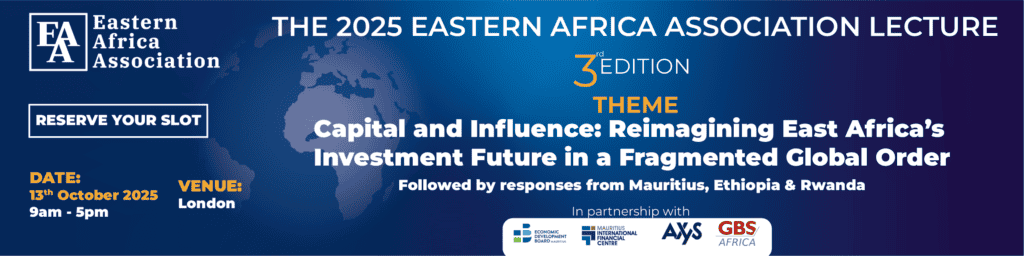
This is the purpose of the 2025 Eastern Africa Association’s Annual Lecture.
The format is a working room, concise briefings, direct exchanges, and time reserved for dealmaking. Professor Victor Murinde, Executive Director of the African Economic Research Consortium, will set out how macro credibility is read by ratings agencies and investment committees, and where emerging guarantee and risk‑sharing capacity can be applied most effectively. A fireside exchange between a senior policymaker and a global fund leader will probe how risk is actually being re‑priced, how national champions are structuring long‑term partnerships and what stacks are genuinely closing in energy, logistics and digital infrastructure.
Country roundtables: Ethiopia, Rwanda, the DRC, Seychelles and Mauritius will then move from principles to pipelines with the officials and operators responsible for delivery. The country roundtables are curated to provide interrogations of readiness and instrument choice, with counterparties in the room who can close.
The Eastern Africa Association’s Annual Lecture exists not for advocacy but to test assumptions and set direction bringing institutional investors, fund managers, DFIs, corporates, government leaders and professional advisers together to examine how finance, trade, energy and geopolitics now intersect in East Africa, and how business can position for long‑term opportunity and to clarify the region’s investable propositions and to define the terms of engagement for a decade in which capital will become more selective, more disciplined, and more decisive.
For governments, this is a platform to demonstrate enforceable policy, transparent pipelines, and the institutional maturity to manage risk. For corporates, it is an opportunity to present offtake and operational credibility. For financiers, it is a chance to match structure to opportunity tenor to project life, risk allocation to counterpart strength, liquidity to timeline.
The date is set: Monday, 13 October 2025, at One Great George Street, Westminster, London.
The room will be ready. The counterparties will be present. And the mandate will be clear.We look forward to welcoming you.
From intent to execution: the institutions that show readiness now will set the price of capital for years to come.”
Agnes Gitau serves as Executive Director at the Eastern Africa Association for the UK and EU region. She is also a Partner at GBS Africa, where she leads political and economic risk advisory across sub-Saharan markets.